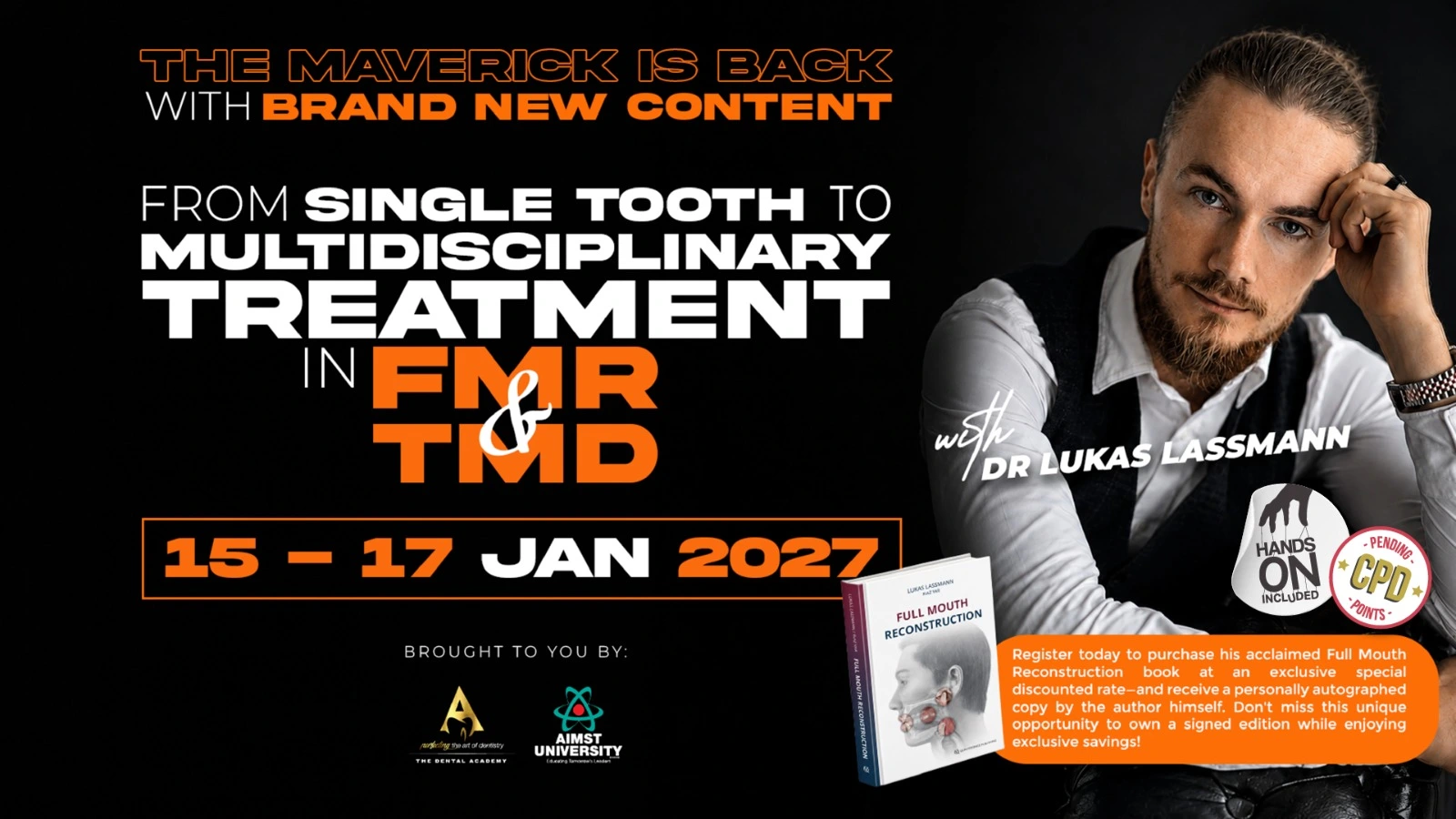
From Single Tooth to Multidisciplinary Treatment in FMR & TMD
15th – 17TH january 2027
Course Coordinator

Dr. Lukas Lassmann D.DS
Dr. Lukas Lassmann has marked his presence as a co-founder and Chief of the Medical Team at Dental Sense clinics in Poland and Norway. At the Polish Academy of Cosmetic Dentistry, he serves as a board member and further extends his contributions as an active member of the American Academy Of Orofacial Pain.
Global Pedagogy & Lectures
Dr. Lassmann is the mind behind the distinguished “Master Level” dental training program. His drive for sharing knowledge has led him to lecture on multiple continents. He has delivered lectures and workshops in esteemed venues across the globe, including but not limited to Dubai in the Middle East, Shanghai in Asia, Lima in South America, Budapest in Europe, and many others such as Cairo, New Delhi, London, Bucharest, Stockholm, Baghdad, and Paris. His international recognition is a testament to his profound understanding and expertise in dental sciences.
Course Curriculum
9:00am – 10:45am
SDS concept
• What is SDS Concept
• Management of TMJ Space
• Controversies regarding centric relation from the perspective of diagnosis and therapy.
• Minimal required space for ceramic restoration
• Smile Design
• How to start treatment planning in severe tooth wear?
• Leaf gauge vs digital axiography
• 18mm rule in severe tooth wear
• Simple way to determine and register exact vertical occlusal dimension in the mouth
11:15am – 1:00pm
SDS concept in multidisciplinary treatment
• SDS Concept – How can we simply determine correct Vertical Dimension of Occlusion on the basis of Smile Design and knowledge of a space required for specific materials.
• Treatment planning in severe attrition and gummy smile
• Cooperation between prosthodontist and orthodontist in cases with deep bite and gummy smile
• Orthodontic pretreatment in class 3 patients who require full mouth reconstruction.
1:00pm – 2:00pm : Lunch
2:00pm – 3:30pm
Save or Extract? — Clinical Decision-Making for the Compromised Tooth — what every restorative dentist should know
• What makes a tooth truly hopeless? Five biological dealbreakers that override every other consideration.
• The ferrule effect — the single most important biomechanical parameter, how to assess it after preparation, and three ways to recover it.
• Four biomechanical red flags: wall thickness, real ferrule, crown-to-root ratio, wall count.
• Patient factors beyond biology — bruxism, perio, finances, and the patient’s own wish. When autonomy should tip the decision.
• Strategic role of the tooth — why the same tooth in different patients gets different answers. Esthetic risk in the young patient.
• The 8-flag decision framework — SAVE, SAVE CONDITIONALLY, or STRATEGIC EXTRACTION — applied to real clinical cases.
4:00pm – 5:30pm : Bite Registration – Make It Easy
• Leaf gauge – What is it? When / should I use it? When not to use it?
• Tips & tricks of how to use leaf gauge
• Demonstration of working with the leaf gauge
9:00am – 10:45am
Understanding Orofacial Pain & TMJ – what prosthodontist should know
• What is pain? How can a dentist correctly diagnose orofacial pain and assess whether it is treatable? How does the source of pain differ from the location of pain?
• How to conduct an interview with a patient suffering from pain.
• Disc pathology – how to differentiate it and when intervention is necessary
• How to distinguish between locks of muscle and articular origin
• Synovial pain map of the temporomandibular joint
• Radiological picture of disorders of the temporomandibular joint
11:15am – 1:00pm
Dental Detective and TMD treatment protocol
Examination of muscles, joints. Demonstration
• Rare and idiopathic conditions in a dental office – what have we learned ?
• Tooth wear How to recognize what caused the destruction of teeth?
• Adaptation – what is it, what are its effects, how to recognize if the patient is already adapted and how to treat in cases of aesthetic and functional reconstructions.
• Role of the diet, sleep, gut microbiota in chronic orofacial pain
• TMD treatment algorithm
2:00pm – 5:30pm
Vertical Occlusal Dimension mythology and severe attrition treatment.
• Vertical occlusal dimension – what are the limitations? Should we be “that” precise ?
• 5 red flags when increasing VDO
• Bite registration in severe wear cases
• Severe tooth wear cases
• What is the ferule effect and which part of the tooth is the most important?
• Biomechanics of damaged teeth
• What type of crown-root post to choose? Standard, fiberglass or cast post?
• Shoulderless preparation. Why? How? When?
4:00pm – 5:30pm : Cementation
• Alghoritm for cement selection
• How to prepare ceramics and teeth for bonding? Is ultrasound better than ortophosphoric acid? Is then alternative to gold standard protocol?
• Rubber dam – split dam or full isolation?
• How to clean contaminated ceramics or tooth- review of the literature
• Adhesive challenges- fluorosis, amelogenesis imperfecta, MIH etc. How to improve bonding?
• Protocol for bonding zirconia.
• How to cover metal posts to maintain proper aesthetics.
• Step by step protocols for cementing and cleaning ceramic veneers
9:00am – 10:30am
Occlusal Philosophies – In Search of a Common Denominator
• How has the approach of occlusal philosophies changed in terms of tooth guidance and its impact on bruxism TMD (Temporomandibular Disorders)?
• The impact of improper occlusion on TMD- correlation or causative relationship?
• Is the use of fully adjustable articulators and a facebow really necessary to achieve proper prosthetic reconstruction?
• In search of a common denominator between different occlusion philosophies.
• What are the limitations of articulators, and can we truly design prosthetic reconstruction that never require adjustment in occlusion?
11:00am – 12:30pm
How to get a perfect bite for our patient?
• What is equilibration? When do we use it and when is it not allowed to do so?
• Differences between equilibration in MIP and in CR.
• Occlusal mantra- what is important and what is not.
• Electronic bite analyzers – T-scan and OccluSense
• Articulating papers- are companies telling us the truth?
• Equilibration of interference during chewing
• Equilibration of guidance
• Equilibration in static and chewing – video step by step
• Occlusion on implants
13:30pm – 15:00pm
Algorithms and Decision Tree for Full Mouth Reconstruction
• When not to change the existing bite?
• When leaf gauge? When Kois deprogrammer? When Splint?
• When should we choose a tool to make bite repeatable and easy to register ? Which tool should we choose ?
• Step by step journey throughout all the appointments and FMR algorithm
• Nightguard/splints – when, what material? How to register the bite for the splint?
• What contacts and guidance should we achieve on appliance? Delivery and relining.
Video: step-by-step procedures from the first visit to cementation
Discussion
Class Highlights & Testimonials
Course Fee
From Single Tooth to Multidisciplinary Treatment in FMR & TMD (January 2027)
(15th – 17th January 2027)
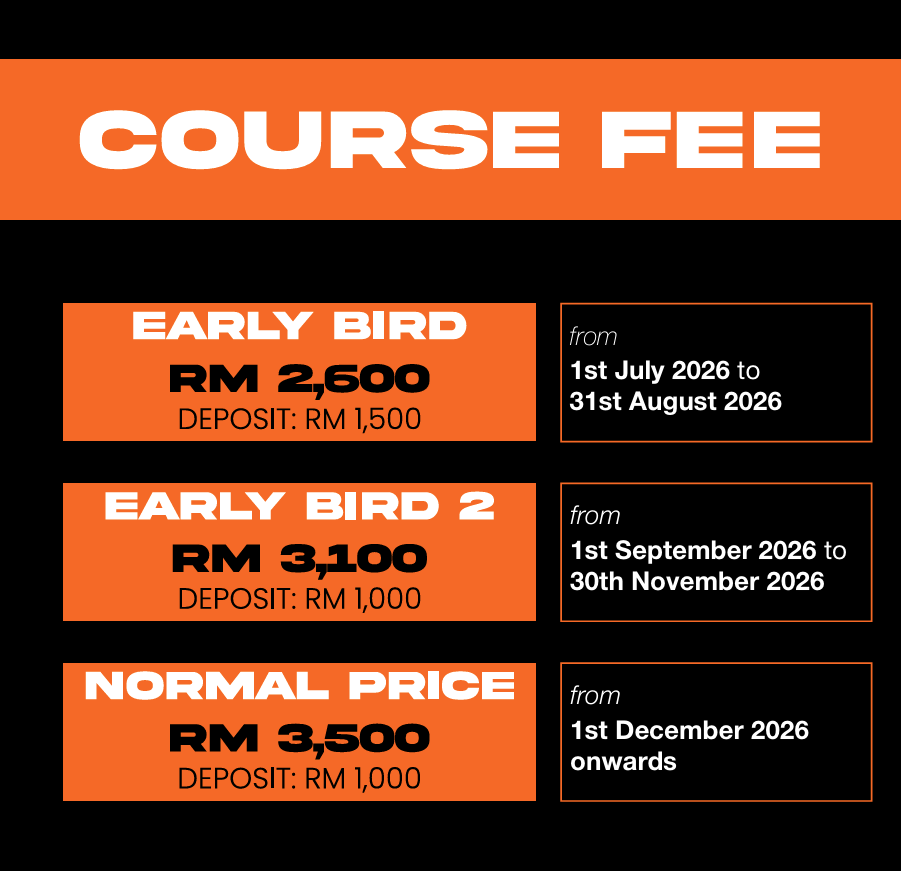
Early Bird : RM 2,600 (1st July 2026 – 31st August 2026)
Deposit – RM 1,500
2nd payment of RM 1,100 by 30th August 2026
Deposit – RM 1,500
2nd payment of RM 1,100 by 30th August 2026
OR
Early Bird 2 : RM 3,100 (1st September 2026 – 30th November 2026)
Deposit – RM 1,000
2nd payment of RM 2,100 by 30th November 2026
OR
Normal Price : RM 3,500 (1st December 2026 onwards)
Deposit – RM 1,000
2nd payment of RM 2,500 by 5th January 2027
Should there be a need to cancel or withdraw from the course for a valid reason, participants must notify us in writing via email at info@thedentalacademy.com.my at least thirty (30) days prior to the course commencement date.
The following refund terms shall apply:
- More than 30 days prior to course commencement: A refund will be issued in the form of store credit only.
- Less than 30 days prior to course commencement: No refunds will be provided and any amount paid shall be forfeited.
- All fees paid are non-transferable to other courses or participants.
- Any refunds or store credits approved will be processed to the original payment method used at the time of registration, where applicable.
- The management reserves the right to amend or make changes to the course due to unforeseen circumstances.