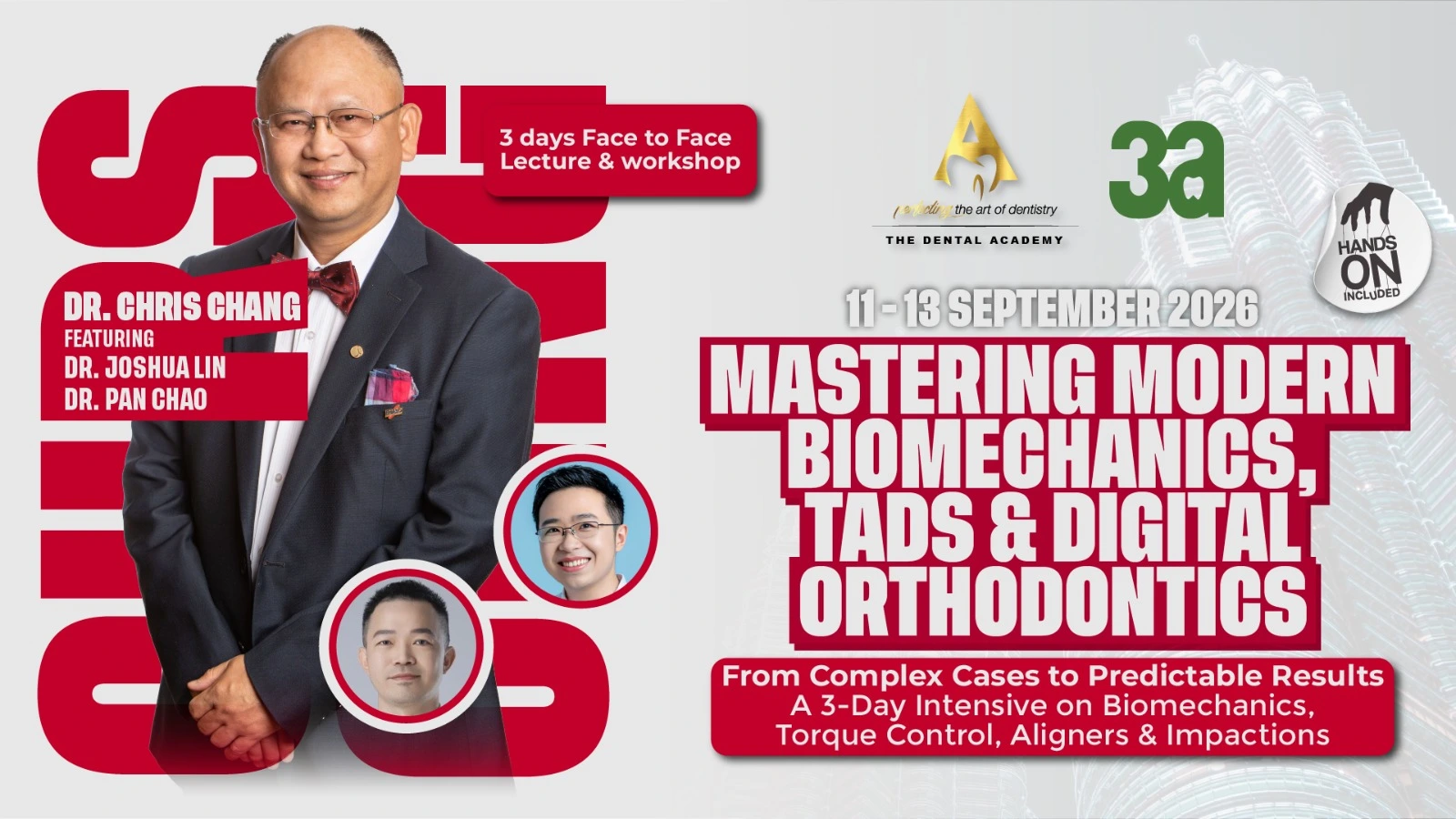
Mastering Modern Biomechanics, Tads & Digital Orthodontics
11th – 13th september 2026
About the Course
Mastering Modern Biomechanics, TADs & Digital Orthodontics is a comprehensive 3-day lecture and hands-on program designed to elevate the way clinicians approach modern orthodontic treatment. This immersive course brings together advanced concepts in biomechanics, Temporary Anchorage Devices (TADs), and digital workflows, empowering dentists to achieve greater precision, efficiency, and predictability in their cases. Participants will gain valuable insights into managing complex malocclusions, including Class II, Class III, and interdisciplinary adult cases, using both fixed appliances and clear aligners.
The first day focuses on mastering torque control and understanding the evolution of orthodontic systems. Clinicians will learn how to achieve precise three-dimensional tooth movement, particularly in non-surgical Class III cases, while exploring innovations in high-precision bracket systems and digital orthodontics. The integration of digital planning with clinical execution will be emphasized, enabling participants to enhance treatment efficiency and consistency while simplifying even the most challenging cases through TAD-supported mechanics.
On the second day, the course transitions into the biomechanics and clinical application of TADs, supported by an intensive hands-on workshop. Participants will learn how to design effective force systems, identify optimal insertion sites, and confidently place TADs in key anatomical regions such as the buccal shelf and infrazygomatic crest. The integration of TADs with aligner therapy will also be explored, equipping clinicians with the ability to overcome traditional limitations and manage complex movements with greater control and predictability.
The final day is dedicated to the management of impacted teeth and advanced clinical applications. Through a combination of lectures and practical training, participants will learn minimally invasive techniques such as VISTA, alongside the use of TADs and 3D mechanics to successfully treat challenging impaction cases. By the end of the program, clinicians will have a complete, structured approach—from diagnosis to execution—allowing them to confidently handle complex orthodontic cases with improved outcomes and reduced treatment time.
Course Coordinators

DR. CHRIS CHANG — Course Director
Dr. Chris Chang is the founder of Beethoven Orthodontic Center and Newton’s A Dental in Hsinchu, Taiwan.
He earned his PhD in Bone Physiology and Certificate in Orthodontics from Indiana University, and is a Diplomate of the American Board of Orthodontics as well as an active member of the Angle Society–Midwest.
Dr. Chang is the publisher of the Journal of Digital Orthodontics and the author or co-author of numerous orthodontic books, including Orthodontics Vols. 1–6, Words of Wisdom, Jobsology, and Trumpology.
He received the 2019 AJO-DO Case of the Year Award and the 2025 John Valentine Mershon Award from the American Association of Orthodontists.
He is also the inventor of the OrthoBoneScrew (OBS®).
DR. JOSHUA LIN — Instructor
Dr. Joshua Shih-Yung Lin, DDS, is an internationally trained orthodontic clinician with a strong focus on advanced, evidence-based treatment. He earned his DDS from Kaohsiung Medical University, Taiwan, and an M.Sc. in Specialized Orthodontics from the University of Duisburg-Essen, Germany. His expertise includes managing complex orthodontic cases, clear aligner therapy (Invisalign and Spark), miniscrew-assisted biomechanics, and the traction of impacted teeth.
A licensed dentist in Taiwan, Dr. Lin is also a certified Invisalign and Spark provider, and serves as an Ambassador for the International Board of Orthodontics & Implantology. He has contributed to leading orthodontic textbooks and authored multiple peer-reviewed publications, with research focused on skeletal anchorage systems, aligner biomechanics, and innovative solutions for complex malocclusions.

DR. PAN CHAO — Instructor
Dr. Pan Chao, B.S., is an experienced orthodontic clinician with a strong background in clinical practice and professional leadership. He earned his Bachelor of Stomatology from Nanchang University, China, and completed a Master of Continuing Education in Orthodontics at the University of Lleida, Spain.
He serves as Vice Chairman of the Orthodontic Committee at Taikang Bybo Dental and Director of Orthodontics for the Jiangxi region, while actively contributing to several professional organizations, including the Jiangxi Provincial Committee of Orthodontics and the Royal College of Surgeons of England (MRCS). Dr. Pan is also an award-winning orthodontist, recognized at national conferences, and the founder of the WeChat platform “Pan Chao Orthodontics,” where he shares insights with the dental community.
Course Curriculum
DAY 1
Topic 1: The Ultimate Torque Control in Class III Treatment
Skeletal Class III malocclusion is often treated after the patient’s rapid growth phase and may require a combination of orthodontic and surgical approaches. For patients pursuing a non surgical, conservative path, success depends on carefully designed three-dimensional tooth movement supported by miniscrews and complemented with auxiliaries such as Class III elastics and torquing springs.
This presentation will feature detailed case reports demonstrating various clinical strategies for achieving precise and effective torque control in Class III treatment.
Topic 2: The Latest High-Precision Fixed Bracket System
This lecture highlights the innovations in orthodontics brought by the new Ultima bracket design, featuring a parallelogram bracket slot and round-sided rectangular wire. These advancements allow for the full expression system, particularly enhancing torque control in incisors. The session will focus on treatment strategies using Ultima brackets, with an emphasis on closing large spaces through the use of Temporary Anchorage Devices (TADs). This cutting-edge bracket design is pivotal in achieving precise torque control and optimizing treatment results.
Topic 3: Digital Transformation: From Fixed Appliances to Clear Aligners
Recent years have witnessed tremendous progress in digital orthodontics. It optimizes the mechanics of fixed appliances through customized brackets, precise indirect bonding, and pre fitted arch wires, while simultaneously serving as the technological foundation driving the evolution and efficacy of clear aligners. By showcasing a diverse range of clinical cases and providing detailed mechanical analyses, this lecture illustrates how digital simulations and software programming significantly elevate both treatment efficiency and consistency in quality.
Topic 4: Tough Cases Made Easy with TADs
Self-ligation systems combined with miniscrews and other orthodontic auxiliaries enable clinicians to create efficient and reliable force systems to solve a wide range of challenging cases. In this lecture, I will demonstrate how to approach common difficult cases, including sagittal, vertical and horizontal problems with simple and reasonable treatment planning. Interdisciplinary treatment of complex adult cases will also be discussed.
DAY 2
Topic 1: Biomechanics of TADs in Orthodontics
Temporary Anchorage Devices (TADs) enhance orthodontic precision by providing absolute stability during tooth movement. This presentation analyzes the biomechanics behind complex movements—including en masse retraction, molar intrusion, and full-arch distalization. Through force vector analysis and clinical case studies, the session demonstrates how mastering TAD biomechanics allows clinicians to design efficient, customized force systems to resolve the most challenging malocclusions.
Topic: Screws and Aligners Workshop Part I – III
Temporary Anchorage Devices (TADs) provide reliable and effective anchorage and can be seamlessly integrated into aligner treatment to address a wide variety of malocclusions. Buccal shelf screws are particularly valuable for camouflage treatment of severe Class III cases and managing lower anterior impactions. Ramus screws are ideal for addressing deep horizontal impactions of the lower arch, while IZC screws are highly effective for correcting Class II malocclusions, upper anterior impactions, and protrusions. In this workshop, participants will learn to select appropriate mechanics, accurately identify insertion sites, and practice placing screws in the buccal shelf, IZC, and anterior zones on models fitted with aligners.
Topic 2: TADs Applications in Orthodontic Treatment (Dr. Pan Chao)
Temporary Anchorage Devices (TADs) provide stable anchorage that significantly expands the capabilities of both self-ligation systems and clear aligners. With self-ligation brackets, TADs create reliable force systems to resolve complex sagittal, vertical, horizontal, and interdisciplinary cases. For clear aligners, TADs overcome inherent biomechanical limits. They facilitate difficult movements—like forced eruption, mesialization, and molar uprighting—by pairing the aligner’s pushing strength with the TAD’s pulling force.
Through clinical case presentations, this lecture demonstrates how strategic TAD integration transforms the toughest orthodontic challenges into predictable, easy-to-manage successes across both major treatment systems.
DAY 3
Topic 1: Hot Tips for Impactions
Impacted teeth are a common yet challenging issue in orthodontics. This lecture offers practical strategies for managing both maxillary and mandibular impactions. Key topics include treatment of impacted maxillary incisors and canines using minimally invasive techniques like VISTA, which preserves gingiva and reduces treatment time. For mandibular impactions, the focus will be on safe and effective biomechanics—such as buccal shelf screws and 3D lever arms—to overcome high bone resistance and anatomical risks. Concrete clinical tips will be shared to enhance precision and efficiency in impaction cases.
Topic 2: Hot Tips for Impactions – Case Reports (Dr. Joshua Lin)
Topic: Impaction hands-on workshop Part I – III
Tooth impaction is a common but challenging problem in our clinical practice. However, it can be easily treated with temporary anchorage devices (TADs) and 3-D lever arms. In addition, TADs have been proven to be extremely reliable and effective in many other skeletal malocclusions, such as Class II correction with infrazygomatic crest (IZC) screws, and camouflage treatment of severe Class III with buccal shelf (BS) screws.
This course begins with basic skeletal anatomy of the bone structure that helps clinicians identify various screw insertion sites. Then participants will then be guided by Dr. Chang, in a step-by-step fashion, to learn how to place screws. The third part is to learn to perform the vertical incision subperiosteal tunnel access (VISTA) technique which, when combined with TADs and 3D lever-arm, can create access to the impacted tooth and later move it into the arch. Complete treatment of canine and molar impaction cases, from diagnoses to screw placement with or without surgical interventions will be thoroughly analyzed.
Course Fee
TIER 1 — RM 5,500 — Super Early Bird
(Limited Seats Available until fully booked or valid until 30th April 2026)
Deposit RM 2,000 (Immediate Payment)
Final Payment of RM 3,500 by 15th July 2026
OR
TIER 2 — RM 6,200 — Early Bird
Deposit RM 1,500 (Immediate Payment)
1st Payment of RM 2,350 by 15th July 2026
2nd Payment of RM 2,350 by 15th August 2026
OR
TIER 3 — RM 6,800 — Standard Rate
Deposit RM 1,500 (Immediate Payment)
1st Payment of RM 2,650 by 15th July 2026
2nd Payment of RM 2,650 by 15th August 2026
Should there be a need to cancel or withdraw from the course for a valid reason, participants must notify us in writing via email at info@thedentalacademy.com.my at least thirty (30) days prior to the course commencement date.
The following refund terms shall apply:
- More than 30 days prior to course commencement: A refund will be issued in the form of store credit only.
- Less than 30 days prior to course commencement: No refunds will be provided and any amount paid shall be forfeited.
- All fees paid are non-transferable to other courses or participants.
- Any refunds or store credits approved will be processed to the original payment method used at the time of registration, where applicable.
- The management reserves the right to amend or make changes to the course due to unforeseen circumstances.