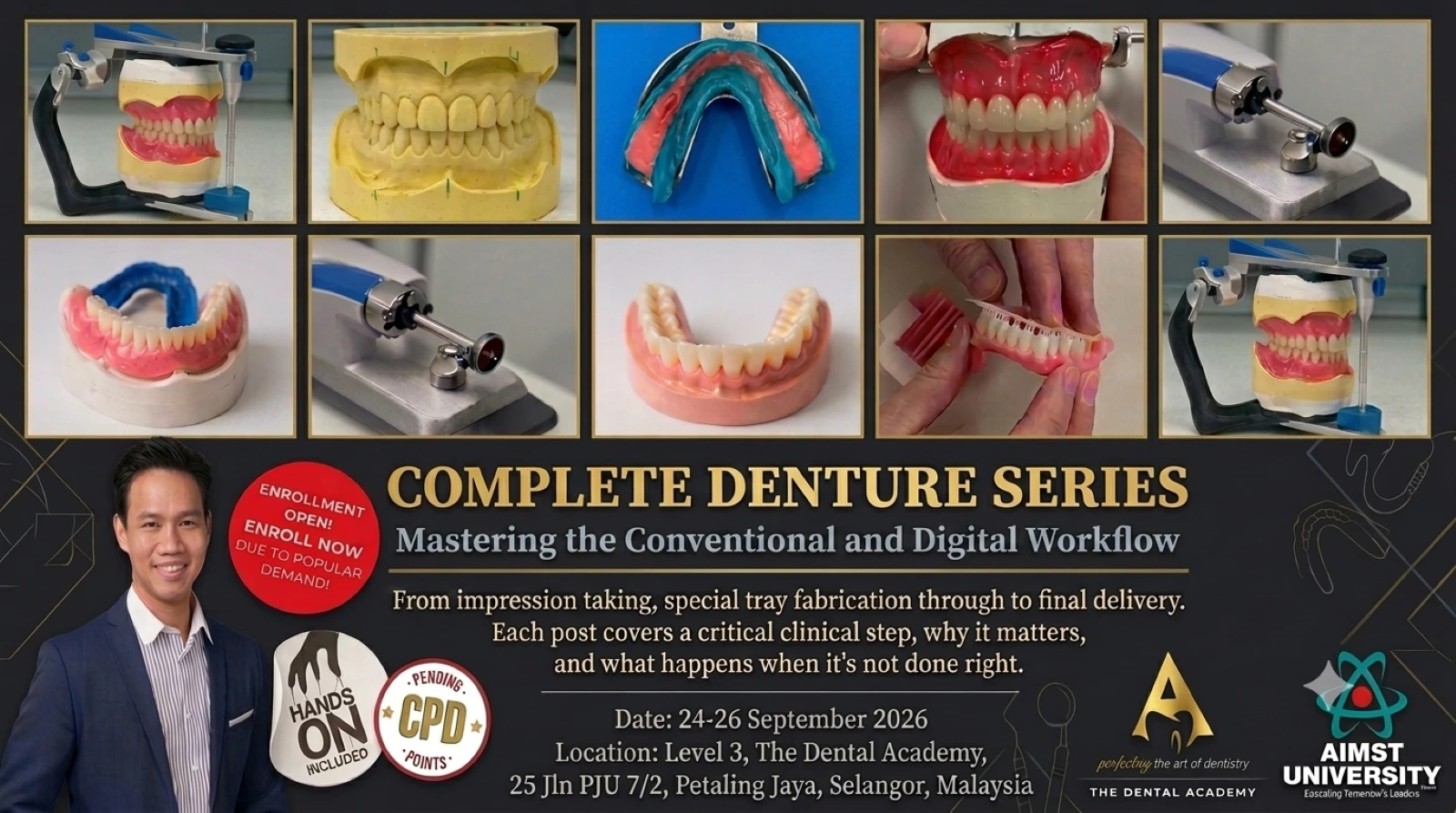
Complete Denture Series (September 2026)
24th – 26TH september 2026
Course Overview & Learning Objectives: Mastering Conventional Complete Dentures with Digital Advancements
This comprehensive course is designed for clinicians looking to eliminate the unpredictability often associated with removable prosthodontics. The program focuses heavily on mastering fundamental conventional protocols—from landmark identification to balanced occlusion—that ensure clinical success. Once these essential analog principles are solidified, participants will learn how to troubleshoot post insertion complaints and explore how to transition these concepts into modern digital workflows, including digital mucostatic impressions, milling, and 3D printing.
Course Learning Objectives
By the end of this course, participants will be able to:
1. Identify Critical Anatomical Landmarks for Denture Success
Biological Foundations: Map and evaluate the primary, secondary, and relief areas of both maxillary and mandibular edentulous ridges to maximize prosthesis retention, stability, and support.
Border Limitation: Accurately identify limiting structures—such as the vibrating line, retromolar pads, buccal shelves, and frenum tissue reflections—to determine the precise functional boundaries of the denture base.
2. Master Advanced Conventional Impression Techniques
Precise Material Handling: Master the uniform softening and tempering protocols of modeling compound to ensure an effective, tissue-safe conventional border molding technique.
Simultaneous Workflows: Implement a streamlined impression technique utilizing monophase polyether to simultaneously perform functional border molding and capture the definitive edentulous impression in a single analog step.
Digital Mucostatic Alternatives: Understand how to apply these classic tissue principles to a digital workflow, utilizing intraoral scanning protocols optimized for capturing a true mucostatic (distortion-free) digital impression without displacing mobile tissues.
3. Achieve Predictable Centric Relation (CR) Records
Bilateral Manipulation Mastery: Confidently execute a controlled, two-handed clinical technique to stabilize both occlusion rims intraorally while smoothly guiding the patient’s mandibular terminal hinge movement.
Stable Record Capture: Utilize specialized materials (Aluwax) to achieve uniform pressure distribution during registration, completely eliminating the sliding, shifting, or displacement of conventional occlusion rims.
4. Apply the Laws of Occlusion & Tooth Arrangement
Harmonize Hanau’s Quint: Synthesize and adjust key conventional occlusal parameters—condylar guidance, incisal guidance, cusp height, and compensating curves—to achieve a highly stable balanced occlusion during teeth setup.
Select Optimal Occlusal Schemes: Critically analyze and select the most appropriate occlusal scheme (anatomical balanced, lingualized, or monoplane/non-anatomical) based on residual ridge morphology.
5. Deliver Predictable Esthetics & Evaluate Manufacturing Methods
Natural Tissue & Tooth Integration: Design an aesthetic prosthesis by harmonizing optimal maximal intercuspation with realistic tooth selection and anatomical gingival festooning.
Conventional vs. Digital Outputs: Contrast conventional processing methods with modern manufacturing, understanding the clinical indications and material benefits of milled PMMA denture bases and 3D printed resins.
6. Diagnose Post-Insertion Complaints & Execute Precise Adjustments
Symptom-Based Diagnosis: Systematically troubleshoot common patient complaints, distinguishing between errors in vertical dimension, occlusal disharmony, or border overextension.
Clinical Problem Solving: Accurately locate sore spots and overextended denture borders using classic indelible pencil clinical transfer techniques or pressure-indicating paste (PIP), executing precise laboratory modifications for immediate patient comfort.
7. Analog Denture
* Master the complete conventional denture workflow from first impression to final insertion.
* Fabricate accurate special trays and perform precise border moulding for optimum retention and stability.
* Record highly accurate final impressions for well-fitting, functional dentures.
* Establish correct vertical dimension, jaw relations, and occlusal records with confidence.
* Record and verify centric relation to minimise occlusal errors and remakes.
* Deliver complete dentures with predictable suction, comfort, function, and aesthetics.
* Apply practical clinical protocols and troubleshooting techniques through real patient demonstrations for predictable everyday practice.
8. Digital Denture
* Understanding different impression protocol or data aquisition for digital CD.
* Differentiate between subtractive (milling) and additive (3D printing) manufacturing for complete dentures.
* Execute accurate intraoral scanning protocols for edentulous arches and existing prostheses.
* Navigate CAD software to design a practical base-and-tooth bonded denture.
* Calibrate 3D printers and select appropriate biocompatible resins for longterm clinical use.
* Perform post-processing techniques, including washing, curing, and characterization (staining) for high-level esthetics.
I. Fundamental of Complete Denture
• Anatomical landmark, denture boundary, pressure VS non-pressure impression technique.
• Border moulding
• Functional Impressions
• Troubleshooting for all your denture problems
II. Analog or The Digital Shift: Why 3D Print?
• Comparison of clinical outcomes: 3D printed vs. conventional heat-cured dentures.
• Material science: Understanding MMA-free resins and their mechanical properties.
• The “Copy Denture” vs. “New Denture” workflow.
III. Analog Impressions & Digital Data Acquisition with Clinical Steps
• Impression methods using greenstick and Zinc Oxide Eugenol (ZOE) – also for Mucostatic Challenging cases
• Intraoral scanning techniques for the edentulous ridge (The “Mucostatic” Challenge).
• Capturing Maxillo-Mandibular Relationship (MMR) using conventional and modified wax rim.
IV. Design & Manufacturing
• Introduction to designing complete denture analog and CAD software (3Shape).
• Nesting and slicing: Orientation strategies to minimize support marks on critical surfaces.
• Post-processing: The critical role of nitrogen-saturated curing for biocompatibility.
• Denture characterization, staining.
Task 1 — The Digital Impression (Hands-On)
Activity: Participants will use an intraoral scanner on edentulous models and bite registration
Goal: Achieve a “green” scan (full coverage) of the hamular notches and retromolar pads within a 5-minute window.
Task 2 — Analog Impression (Hands-On)
Activity: Participants will do border moulding and impression taking with ZOE on models.
Goal:
1) To learn the extension of border moulding and to be able to grasp and learn effectively how to get suction through your border moulding manually.
2) The goal is to capture the tissue at rest while maintaining the functional depth and width of the sulcus established during border moulding.
Task 3 — CAD Design Simulation
Activity: Using a provided dataset, participants will:
• Define the denture base periphery.
• Perform a virtual “Trial Placement” (Tooth Arrangement).
• Adjust the occlusion for various schemes.
Task 4
Activity: After impression taking, participants will be able to learn the Maxillo Mandibular Relationship Technique (MMR) and Before teeth can be arranged, we need to establish the correct vertical and horizontal jaw relationships , and that starts with the occlusal rims.
Goal: To get A well-constructed occlusal rim gives the dental technician the blueprint they need.
Task 5 — Printing & Post-Processing
Activity: Live demonstration of nesting software.
Goal: Participants will practice removing supports from a pre-printed denture base and perform “wet-bonding” of the teeth to the base using a light-cure resin.
Task 6 — Esthetic Characterization
Activity: Applying gingival staining kits to the 3D-printed base.
Goal: Create realistic gingival architecture and transition zones.
Course Coordinator

Assoc. Prof. Dr. Chaimongkon Peampring
Assoc. Prof. Dr. Chaimongkon Peampring is a distinguished prosthodontist with extensive academic training and leadership experience in restorative dentistry. He obtained his Doctor of Dental Surgery (DDS) from Prince of Songkla University, Thailand, and pursued advanced specialization at Boston University, USA, where he completed both a Certificate of Advanced Graduate Study (CAGS) and a Doctor of Sciences in Dentistry (DScD) in Prosthodontics. He is also a Diplomate of the Thai Board of Prosthodontics under the Royal College of Dental Surgeons of Thailand.
Currently, Dr. Peampring serves as the Department Chair of Prosthetic Dentistry at Prince of Songkla University and as the Scientific Chair for the Private Dentist Association of Thailand. With a strong focus on education, research, and clinical excellence, he continues to play a key role in advancing prosthodontics both in academia and professional practice.
Course Curriculum
DAY 1
09.00-11.00 — Recap denture principle: Anatomical landmark, Impression technique, Denture occlusion (Lecture)
11.00-12.30 — Analog & Digital denture concept (Lecture)
12.30-13.30 — Lunch
13.30-15.00 — Live demonstration analog impression & digital scan on real case scenario
15.00-17.00 — Hands on analog & digital workflow of edentulous ridge
DAY 2
09.00-11.00 — Live demonstration of denture design
11.00-12.30 — Live demonstration of denture fabrication
12.30-13.30 — Lunch
13.30-14.30 — Live demonstration of denture finishing
14.30-16.00 — Post insertion complication
DAY 3
09.00-10.00 — Live demonstration denture insertion
10.00-12.00 — Denture characterization and hands-on denture staining
12.00-12.30 — Certification
Class Highlights & Testimonials
Course Fee
Complete Denture Series (September 2026)
RM 2,850.00 (until 31st July 2026)
Deposit of RM 1,000 (Immediate Payment)
Final payment of RM 1,850 by 25th August 2026
OR
Normal Price : RM3,600 (1st August onwards)
RM 1,000 : Deposit (Immediate Payment)
RM 1,300 : 1st Payment by 15th August 2026
RM 1,300 : 2nd Payment by 15th September 2026
Should there be a need to cancel or withdraw from the course for a valid reason, participants must notify us in writing via email at info@thedentalacademy.com.my at least thirty (30) days prior to the course commencement date.
The following refund terms shall apply:
- More than 30 days prior to course commencement: A refund will be issued in the form of store credit only.
- Less than 30 days prior to course commencement: No refunds will be provided and any amount paid shall be forfeited.
- All fees paid are non-transferable to other courses or participants.
- Any refunds or store credits approved will be processed to the original payment method used at the time of registration, where applicable.
- The management reserves the right to amend or make changes to the course due to unforeseen circumstances.